
Professional Drop Ceiling Installation in Mentor, Ohio: A Homeowner's Guide
7/21/2025
Why Mentor Homes Are Such Good Candidates for Drop Ceilings
Mentor is full of great basements — and a lot of those basements have great bones but bad ceilings. Whether you're in a 1960s ranch off Mentor Avenue, a colonial near Headlands Beach, or a newer build in the Heisley corridor, the story is usually the same: clean concrete floor, framed walls, sometimes even insulation already up — but the ceiling overhead is a mess of joists, pipes, ductwork, and dangling electrical. A professional drop ceiling installation is often the single biggest cosmetic upgrade you can make to that space, and Mentor's housing stock is uniquely well-suited for it. Here's what to know if you're considering one.
Local Quirks That Affect a Mentor Drop Ceiling Project
Every neighborhood we work in has its own little patterns. In Mentor specifically:
1. Lake Effect Humidity
Mentor's proximity to Lake Erie means summer basement humidity is real. We typically recommend at least moisture-resistant edge tiles for any basement project here, and full vinyl-faced or moisture-rated tiles if your basement runs visibly damp. A good dehumidifier helps, but the tiles themselves are the first line of defense against sagging or yellowing over time.
2. Older Sewer Stacks and Cast Iron Drains
Many homes east of Mentor Avenue still have original cast iron drain stacks. These are taller, wider, and heavier than modern PVC, and they shape where the grid can go. Good planning lets us drop the ceiling cleanly without cutting tiles into weird shapes around the stacks.
3. Steel I-Beams and Lally Columns
A lot of Mentor homes from the 1950s–1980s use a steel I-beam down the centerline of the basement, supported by lally columns. Working around these is routine for us — we either trim cleanly around them with wall angle on the beam itself, or wrap them as part of a soffit detail.
4. Radon Mitigation Systems
Mentor sits in a moderate radon area, and many basements either have or will have an active radon mitigation system. The pipe usually runs floor-to-ceiling along one wall and out through the rim joist. We always plan for a clean cut around radon pipes and leave an access tile nearby for future fan replacement.
5. Newer Construction (1995–Today)
Newer Mentor builds tend to have higher basement ceilings (often 8'6" or 9') and tidy mechanicals, which gives more flexibility. In these homes, you have a real choice between drop ceiling and drywall — and either can look great.
What "Professional Installation" Actually Means
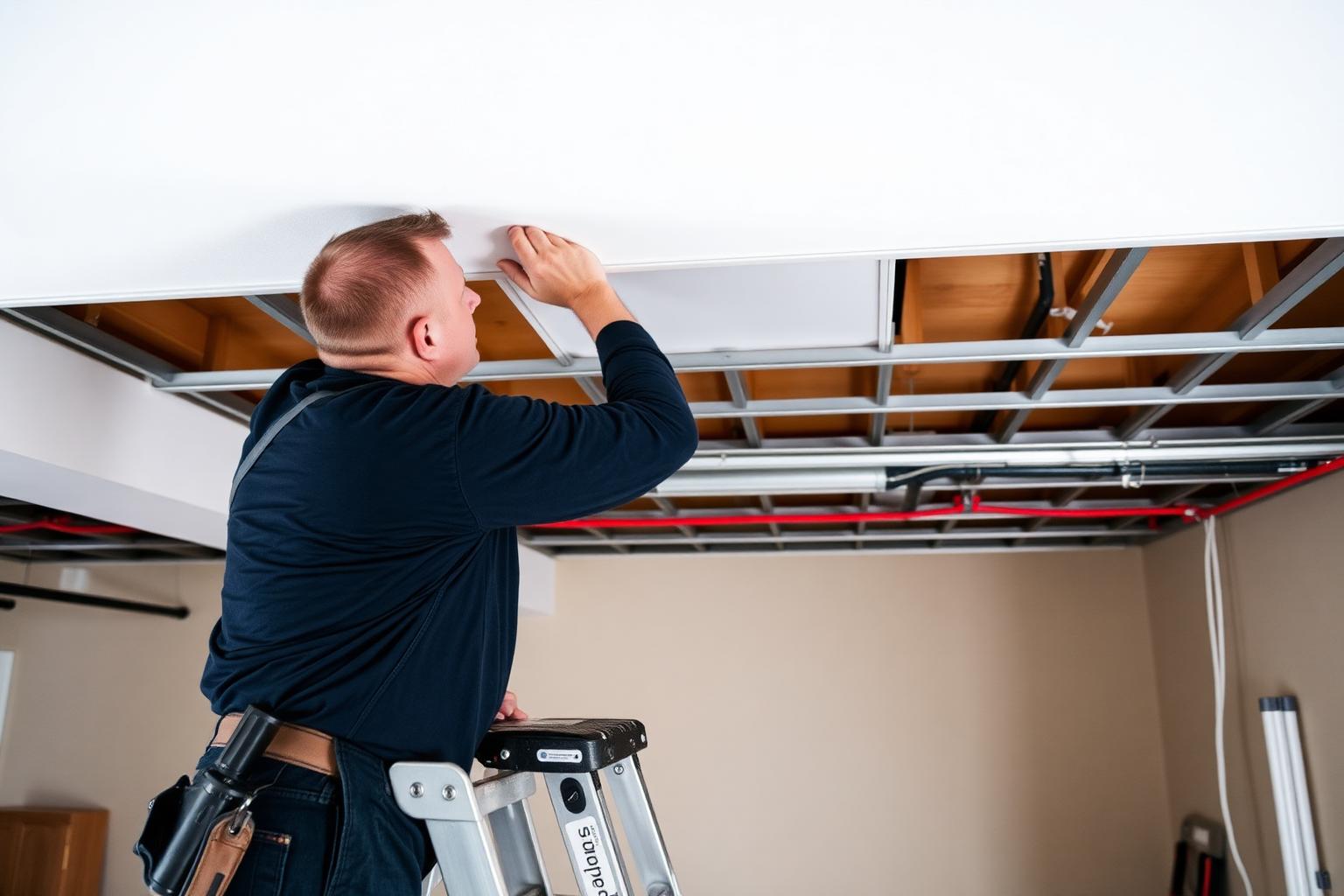
A drop ceiling is one of those projects that looks easy on YouTube and is easy to get wrong. The difference between a professional install and a weekend DIY job usually comes down to four things.
1. Layout Planning
Before any wall angle goes up, we draw the grid on paper and figure out where the border tiles will land. The goal is balanced borders on opposite walls — no thin slivers, no awkward tile sizes around the lights. This is the single most important step for the finished look.
2. True Level
We use a self-leveling laser to set the ceiling height around the entire perimeter. "Close to level" isn't good enough — even a quarter-inch slope across a 20-foot room becomes obvious once tiles are in and lights are on.
3. Square Grid
A grid that's slightly out of square will mean tiles that look crooked from every angle in the room. Pros measure diagonals at multiple points and adjust before the cross tees lock in. DIYers usually don't.
4. Clean Cuts
Border tiles need to be cut individually — measured at each location, scored cleanly, and trimmed for a tight fit. Cuts around lights, vents, and pipes need to be neat enough that the eye doesn't catch them. This is where speed and experience really show.
Lights, Vents, and Other Integrations
Most homeowners want more than just tiles — they want a finished ceiling with proper lighting and clean integration with HVAC and other systems. We routinely handle:
- Recessed LED panel lights sized to match the grid (2x2 or 2x4)
- HVAC supply and return vents with proper trim
- Sprinkler heads in basements that have them
- Smoke and CO detector relocations when needed
- Access tiles above shutoff valves, sump pumps, and electrical panels
When new lighting requires new circuits or switches, we coordinate with a licensed electrician.
Do You Need a Permit in Mentor for a Drop Ceiling?
For a simple drop ceiling installation with no new electrical work, a permit is usually not required in the City of Mentor. If you're adding new lighting circuits, switches, or anything tied into the home's electrical service, the electrical work itself typically requires a permit and inspection. We'll let you know during the estimate which side of that line your project falls on. When in doubt, the Mentor Building Department is generally helpful with quick questions.
What a Mentor Drop Ceiling Project Typically Looks Like
For a typical Mentor basement (say, 700 square feet, standard 2x2 white tiles, six recessed LED panels), a complete drop ceiling installation usually:
- Takes 1.5–2 working days on-site
- Runs roughly $3,500–$6,000 installed
- Lowers the existing ceiling 3–4 inches
- Includes layout, materials, install, trim around obstructions, and clean-up
Larger basements, premium tiles, or extensive lighting can push the timeline and cost up. We'll always give you a written, no-surprises estimate before any work starts.
How to Choose a Drop Ceiling Installer in Mentor
A few things worth asking any installer:
- Will you do a layout drawing before ordering materials? A "yes" here separates pros from improvisers.
- Do you have photos of recent local jobs? Look at corners, light integrations, and border tiles in the photos — that's where quality shows.
- How will you handle obstructions? Beams, ducts, columns, and radon pipes all need a plan.
- What tile do you recommend for my basement? A good installer will ask about humidity and use before recommending.
- Are you insured and local? Local installers stand behind their work and are easier to call back if something needs adjusting.
We try to answer all five before you even ask. You can read more about how we approach drop ceiling installation across Lake County and our broader work in Mentor.
Common Mentor Homeowner Questions
How long will my basement be out of commission? Most projects are a day or two. We work cleanly and confine the dust as much as possible.
Can you match an existing drop ceiling in another part of the house? Yes — bring us a sample tile or send a photo and we'll match it.
Can you remove an old drop ceiling and replace it with a new one? Absolutely. Removal and disposal of the old grid and tiles is included in our quote when applicable.
Do you do small jobs — just replacing damaged tiles? We do. If you have water-stained or broken tiles after a leak, we'll come match and replace them.
Ready to Get Started?
If you're in Mentor and you've been staring at your basement ceiling thinking "someday," we'd love to come take a look. Call or text Lake County Handymen at 330-715-5042, or request a free drop ceiling estimate. We serve homeowners throughout Mentor and the rest of Lake County — and we'll come measure, talk through tile and lighting options, and give you a clear written quote with no pressure.