
Before and After: Transforming an Unfinished Basement with a New Drop Ceiling
12/18/2025
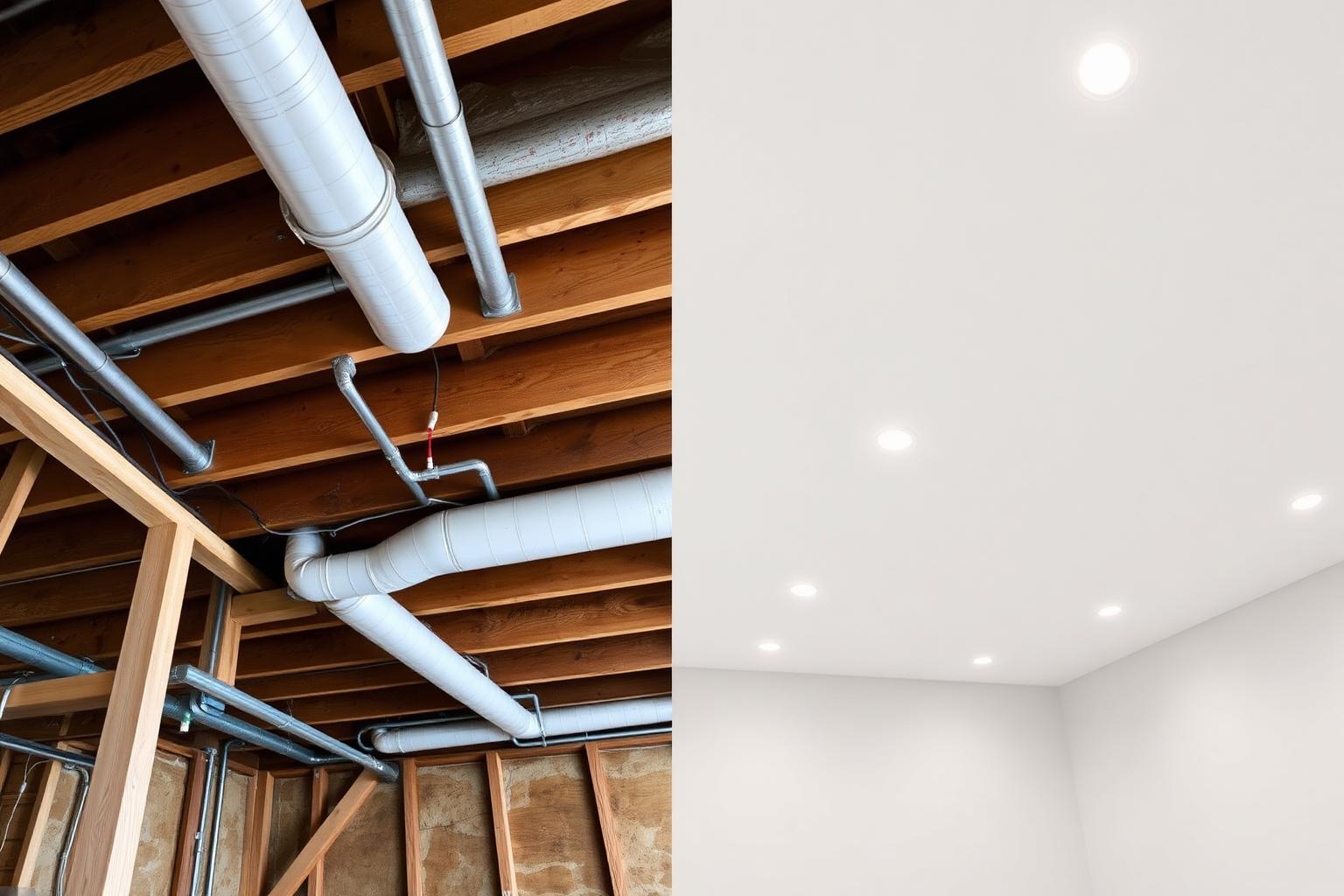
From Exposed Joists to Finished Space — A Real Lake County Basement Project
There's a moment in every basement project where the room finally starts to feel like an actual room. For most homeowners, that moment is when the ceiling goes up. Walls can be primed and painted, floors can be installed, trim can go around the windows — but until something covers up the maze of joists, pipes, ductwork, and tangled wiring overhead, the basement still feels like a basement. This is the story of one recent project where a new drop ceiling installation completely changed how a Lake County family used their lower level.
The "Before": Useful Space, But Not Inviting
The homeowners had been using their basement for years — as a laundry room, a workout corner, a kids' play area, and a place to stash holiday decorations. But none of it really worked, and everyone tended to head right back upstairs after a few minutes.
The ceiling was a big part of the problem. Like a lot of Lake County basements built in the 1970s and 1980s, this one had:
- Exposed wood joists, mostly clean but a little dusty
- A main HVAC trunk and supply runs zig-zagging across the room
- Cast iron and PVC plumbing stacks
- A few generations of electrical wiring stapled here and there
- Bare bulbs in old porcelain fixtures
- A radon mitigation pipe running floor to ceiling along one wall
Nothing dangerous, nothing broken — just busy. Visually busy. And dim, because two bare bulbs can't light an 800-square-foot room evenly no matter how hard they try.
What the Homeowners Wanted
When we walked the space, the homeowners' goals were straightforward:
- A clean, finished ceiling that wouldn't look out of place in a remodeled basement
- Plenty of bright, even light without lamps everywhere
- Easy access to plumbing — they'd already had one slow drip from an upstairs bathroom and didn't want to think about a drywall repair if it happened again
- Reasonable budget, since the rest of the basement (floors, walls, trim) was still to come
A drop ceiling was the obvious match. They got the clean finish, they preserved access to every line above the grid, and they kept enough budget left over to do the floors right.
The Plan
We measured the room, mapped out the existing obstructions, and drew up a grid layout on paper before ordering anything. A few decisions shaped the plan:
- 2x2 smooth white tiles for a more modern, less "office building" look
- Eight recessed LED panel lights integrated into the grid, on two switches with dimmers
- A balanced layout so border tiles were equal on opposite walls — no thin slivers
- Access tiles flagged above the laundry shutoffs and the radon pipe
- Final ceiling height of 7'4" — the lowest we could go cleanly without dropping below the bottom of the HVAC trunk
The Install
Most basement drop ceilings take us one to two full days. This one took just under two.
Day One
We started by snapping level lines around the entire perimeter with a laser, then fastened wall angle into studs at the marked height. With the perimeter set, we hung the main runners from the joists using support wire at the standard spacing, then locked in the cross tees to form the grid. By the end of the first day, the grid was complete, square, and level — but still empty.
Day Two
Day two was tile and trim day. The homeowner's electrician (we work with several locals if you need a referral) had pre-wired the eight LED panel locations, so we dropped those into the grid first, hooked them up, and confirmed everything worked on both switches. Then we filled in the full tiles, measured and cut each border tile individually, and trimmed cleanly around the radon pipe and a steel support post.
The last hour was clean-up — packaging, tile cutoffs, ladder marks vacuumed off the slab — and a walkthrough. The homeowner switched the lights on, looked up, and said the thing we hear on almost every job: "Why didn't I do this years ago?"
The "After": Same Room, Different Space
The transformation isn't dramatic in the way a kitchen remodel is dramatic. There are no new walls, no new flooring, no new appliances. The change is more subtle than that — and somehow bigger. The room reads as a finished room now. The eye stops looking up at obstructions and starts taking in the actual space. The light is even. The acoustics are softer (drop ceiling tiles absorb a noticeable amount of sound). And the whole basement suddenly feels like square footage worth furnishing.
A few weeks after the install, the homeowners sent us a photo: a sectional, a rug, a TV mounted on the wall, and one of the kids spread out on the floor with Legos. Same basement. New life.
Lessons from the Project
A few things we'd tell anyone considering a basement drop ceiling:
- Don't skimp on the lighting. Recessed LED panels are the single biggest upgrade you can make. They're brighter, cheaper to run, and dramatically more attractive than bulbs in surface fixtures.
- Plan the border tiles before you order materials. A balanced grid is the difference between a ceiling that looks intentional and one that looks like it was thrown up in a weekend.
- Flag access tiles on day one. Mark every spot above plumbing shutoffs, electrical junction boxes, and HVAC dampers. Future-you will appreciate it.
- Take your time on the perimeter. A level, well-fastened wall angle is what makes everything else look square.
- Consider moisture-rated tiles in damp basements. Lake Erie summers test every basement; standard tiles can yellow or sag if humidity stays high.
Could Your Basement Use the Same Treatment?
If your basement has been "almost a room" for years, a new drop ceiling is often the single change that finally tips it into being a real, usable space. We'd love to come take a look. Call or text Lake County Handymen at 330-715-5042, or request a free drop ceiling estimate online. We work throughout Mentor, Willoughby, Willoughby Hills, Eastlake, Painesville, Kirtland, Willowick, Wickliffe, and we'll walk through layout, tile choices, and lighting options with you on-site — no pressure, no obligation.